Half of Indian Students Would Have Picked a Different College -- If Better Information Had Been Available
May 14, 2026
HT Syndication
New Delhi [India], May 14: How do Indian students actually choose a college? And once they're inside, how does the experience compare to what they were promised?
A new study from FindMyCollege.com set out to answer both questions. The platform serves over five million student searches a year. For this study, it surveyed current students and recent graduates from across India.
The findings are uncomfortable.
Students rely most on placement data, salary figures, and recruiter lists. These are also the things they later call inflated, hard to find, or missing. The information that is reliable -- like fees -- rarely drives the decision. The gap between what was promised and what was delivered is widest in exactly the categories that motivated the choice.
The study covers a broad cross-section of Indian higher education. Respondents come from central universities, state universities, private universities, deemed universities, autonomous colleges, and affiliated colleges. Streams range from B.Tech (CSE/IT, Mechanical, Civil, Biotechnology) to BA, B.Sc, Humanities, BBA, B.Com, MBA, BPT, and CS Honors. Hometowns span metros and smaller cities.
The full interactive report is at findmycollege.com/research-college-information-gap-india-2026.
More than half would choose differently today
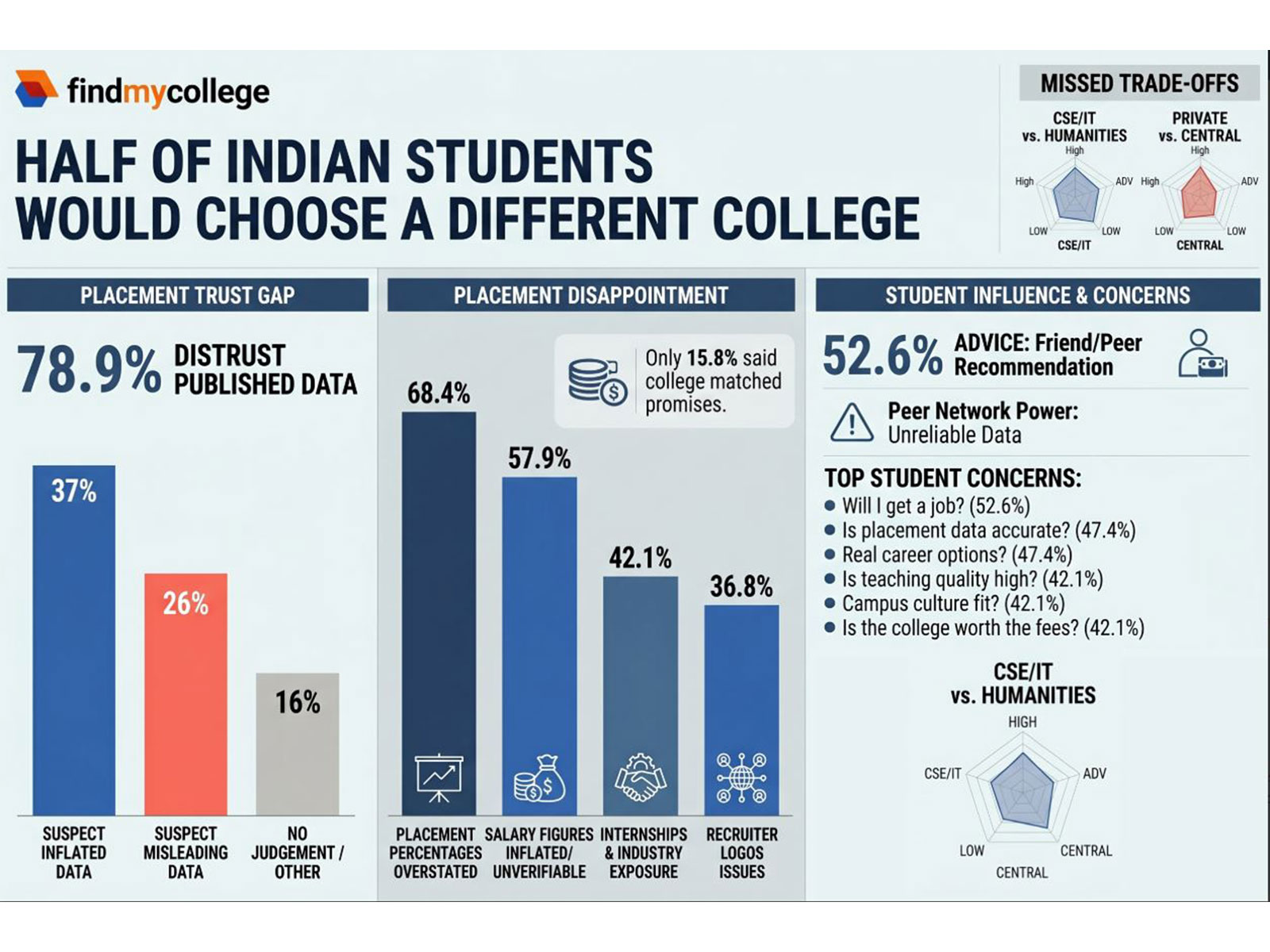
Would better information have changed their college decision? 53% said yes -- they would probably or definitely have chosen a different college or stream. Another 37% said the possibility could not be ruled out. Only 11% felt fully confident in their original choice.
Friends decided. Counsellors didn't.
When asked which single source most influenced their final choice:
* 52.6% named friends or peer recommendations
* 15.8% credited college visits
* 10.5% relied on aggregator websites
* 10.5% on WhatsApp groups or family contacts
* 0% named a college counsellor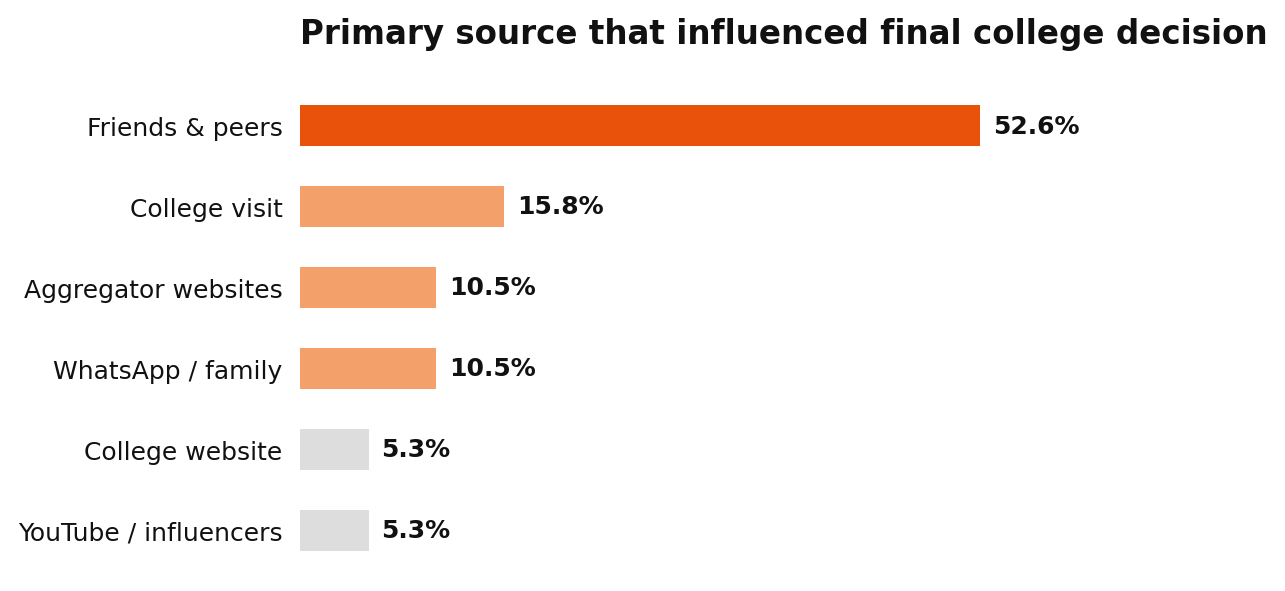
The questions students were actually trying to answer were about outcomes, not inputs:
* 52.6% -- Will I actually get a job after this degree?
* 47.4% -- Is the placement data being shown accurate?
* 47.4% -- What are my real career options after graduation?
* 42.1% -- Is this college worth the fees?
* 42.1% -- What is the actual quality of teaching?
* 42.1% -- What is campus culture really like?
Nearly four in five don't trust placement data
Only 21.1% fully believed their college's published placement numbers. The other 78.9% were divided three ways. 36.8% felt the figures were inflated but had nothing to compare against. 26.3% suspected they were outright misleading. 10.5% had no way to judge.
That suspicion turned out to be well-founded. After enrolling, students compared what they had been told with what they actually experienced:
* 68.4% said placement percentages were overstated
* 57.9% said salary figures were inflated or unverifiable
* 42.1% said internships and industry exposure fell short
* 36.8% said recruiter logos on the placement page were misleading
* 26.3% said campus culture was different from how it was presented
Only 15.8% said the college matched its promises across the board. Fees were a different story -- 90% said fees met or came in below expectations. And 26% said faculty quality was actually better than communicated.
What students could find -- and what they couldn't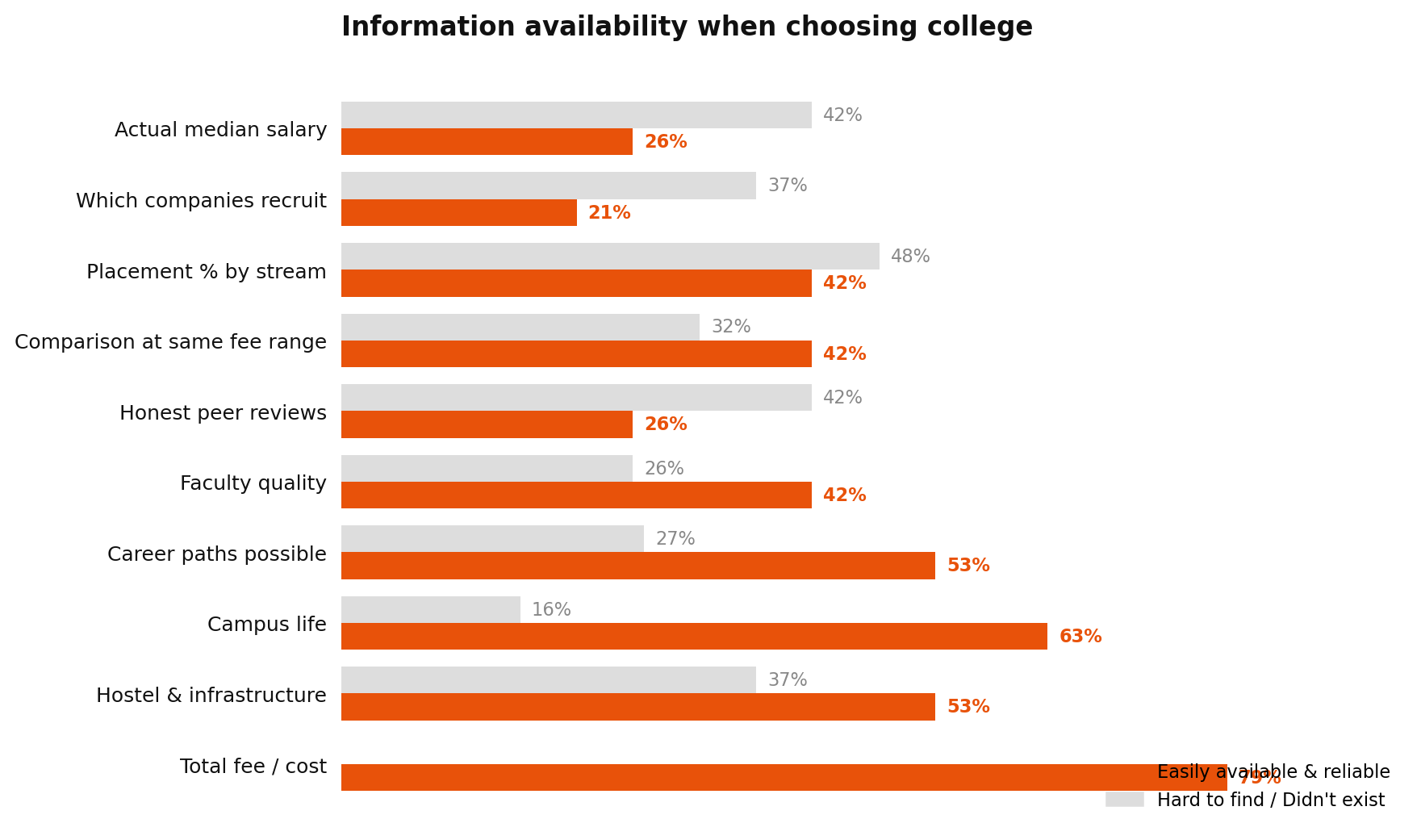
Respondents rated ten categories of college information. Was each one easily available? Available but unreliable? Hard to find? Or non-existent?
The pattern was clear. Reliability collapses as the topic moves from fees toward outcomes.
* Total fee structure -- 79% rated it easily available and reliable. The most trustworthy category in the study.
* Placement percentage by stream -- 42% found it easily. 37% said it was very hard to find. 11% said it didn't exist. 11% said the numbers felt inflated.
* Actual median salary after graduation -- Only 26% found it easily and reliably. 32% found numbers but distrusted them. 21% said it was very hard to find. 21% said it simply did not exist.
* Which companies actually recruit, and for which roles -- 21% rated it easily available and reliable. 42% found data they considered misleading. 26% said it was hard to find. 11% said it didn't exist.
A 1.4-point gap between best and worst
Respondents rated each dimension of their college experience on a 1-5 scale. The overall average was 3.7. Administration and fee transparency averaged 4.1 -- the highest dimension. Placement support and outcomes averaged 2.7 -- the only dimension below 3.0.
That's a 1.4-point gap between best and worst.
Here's the catch. Placements, internships, and industry exposure are the dimensions students reported as most disappointing. They are also the dimensions the original college decision was made on.
Central vs Private: same average score, very different experiences
Private and central university students arrived at near-identical overall averages -- 3.9 and 3.8. But the underlying scores diverge sharply:
* Teaching quality: Central 4.8, Private 3.4. A 1.4-point gap favouring central.
* Value for money: Central 4.5, Private 3.6. A 0.9-point gap favouring central.
* Industry exposure: Private 3.7, Central 2.5. A 1.2-point gap favouring private.
* Placement support: Both scored below 3.0.
In practical terms, choosing a private university over a central one is a trade. You gain +1.2 points of industry exposure. You lose 1.4 points of teaching quality. Few respondents said this trade-off was made explicit before they enrolled.
CSE/IT and Humanities: same college, different worlds
Splitting the experience by stream reveals a similar pattern.
* CSE/IT students rated infrastructure 4.5/5 and campus culture 4.3/5. Humanities students rated the same dimensions 3.8 and 3.3.
* Humanities students rated teaching quality 4.4/5 and value for money 4.3/5. CSE/IT students rated the same dimensions 3.3 and 3.4.
Both streams converged on equally low placement satisfaction. The trade-off is real. But the data students need to navigate it is missing.
More research did not lead to more confidence
Among students who researched for less than two weeks, 80% said better information would have made them at least reconsider. Among those who researched for more than two months, the figure was 25%.
But here's the key finding. The share who would have made a completely different choice barely moved across any research-time band. Not even the longest.
The implication is uncomfortable. The missing information was simply not out there to be found -- no matter how long students looked.
A metro-versus-smaller-city information divide
78.9% of respondents said students from smaller cities have less access to reliable college information. That includes respondents who themselves grew up in metros. 36.8% described the gap as significant. 42.1% said metro students hold a meaningful advantage. Only 15.8% said information is equally accessible everywhere.
A second finding sits alongside this one. Smaller-city students reported worse information access at the research stage. But once enrolled, they rated their college experience higher than metro students did (3.9 vs 3.2).
The most likely explanation? Calibrated expectations and fewer reference points. Not better colleges.
The career-counsellor gap
* 15.8% had a college counsellor who was genuinely helpful
* 31.6% had never thought about whether they had access to one
* 21.1% had no counsellor at all
* 21.1% had a counsellor but never interacted with them
* 10.5% had a counsellor whose knowledge of their stream fell short
The five missing data points
What was the single most important piece of information that didn't exist anywhere?
Respondents converged on five answers:
1. Verified placement data, broken down by stream and graduation year
2. Which companies actually recruit from this college, and for which roles
3. Real salary data from alumni one to two years after graduating -- not college-reported
4. Verified peer reviews from currently enrolled students
5. A value-for-money score comparing colleges in the same fee range
Four of the five are about verifying what colleges already publish. Not about getting more information.
In their own words
"The placement statistics that were claimed and the placement support actually delivered were very different." -- B.Tech CSE graduate, Private University * Lucknow → Jalandhar
"The biggest information gap was the lack of transparent, verified data about actual branch-wise placements and the real salaries alumni receive after graduating." -- BBA / B.Com graduate, Private affiliated college * Lucknow
"The hardest thing to find was honest information about what opportunities and career support students actually receive during and after college." -- Humanities graduate, Government State University * Patna
"The cream courses and cream colleges are discussed everywhere -- but no one goes beyond them. Knowing which lesser-known college is good for which course would have been useful." -- Humanities graduate, Central University * Delhi
"Placements were different from expectation. If you are dependent on the college, you won't get a good job -- you need to prepare yourself." -- B.Tech CSE graduate, Private University * Nagpur
"Placement stats -- number of students placed, starting salary expectations. Both inflated. Tuition fees also climbed year-on-year." -- B.Tech CSE student, Private University * Muzaffarnagar → Greater Noida
Methodology
A mixed-method survey. It combined structured Likert items, multi-select and single-choice questions, and four open-text response prompts. Respondents self-selected from FindMyCollege.com's audience and partner channels. Participation was voluntary and uncompensated.
Self-selection bias is acknowledged. Respondents who chose to take a survey on this topic likely hold stronger views than the average enrolled student. Quantitative shares should be read as directional indicators, not nationally representative estimates.
The qualitative pattern is robust. Which information was missing, who decided the choice, where colleges over-promised -- these are consistent across institution type, stream, and geography.
About FindMyCollege
FindMyCollege.com is India's college search and discovery platform. It serves over five million student searches a year across thousands of institutions. The platform provides college information, cutoff data, and student-verified reviews.
Contact
FindMyCollege Research product@findmycollege.com Full report: findmycollege.com/research-college-information-gap-india-2026
(ADVERTORIAL DISCLAIMER: The above press release has been provided by HT Syndication. ANI will not be responsible in any way for the content of the same.)