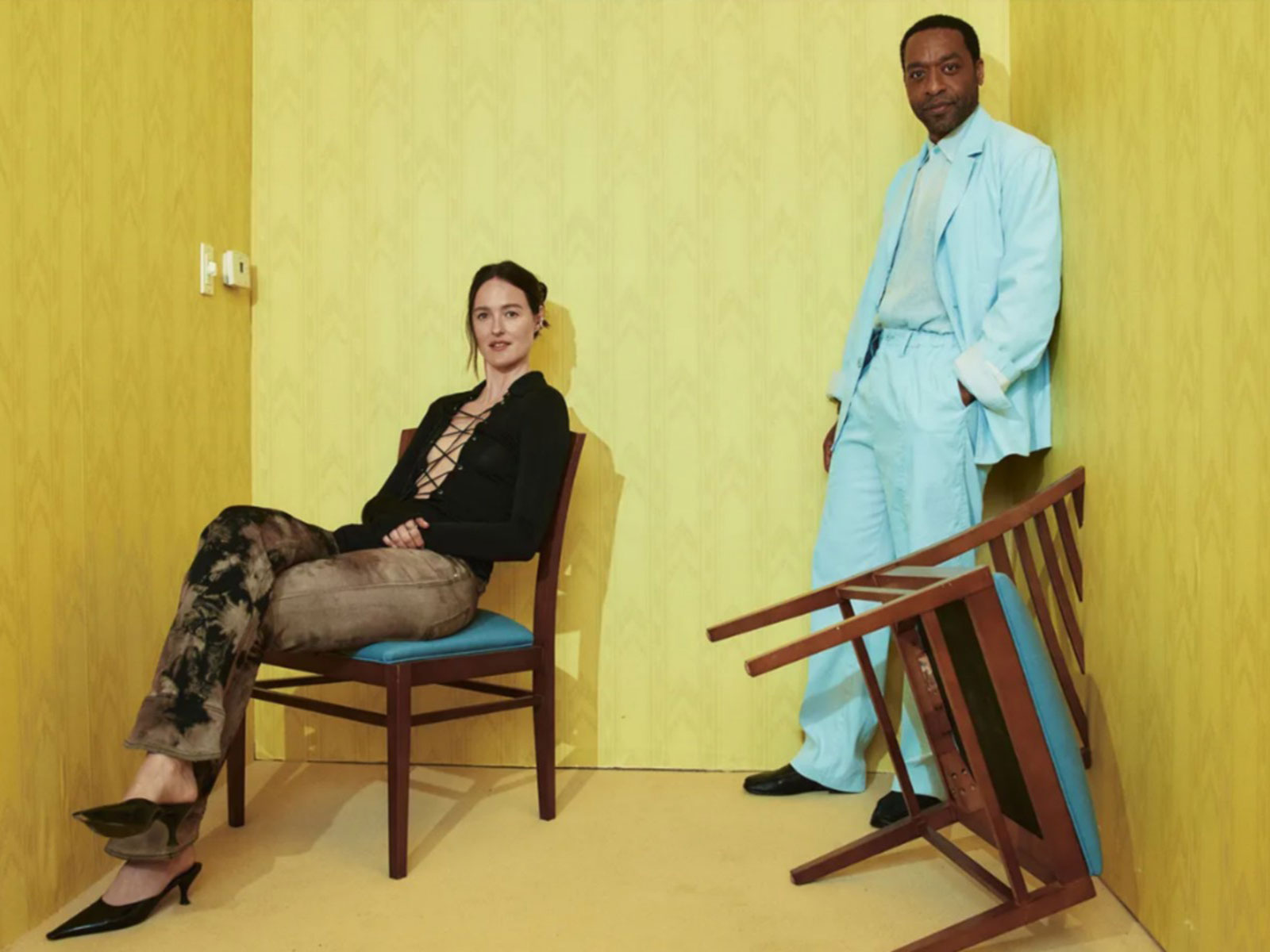
Parsons' Backrooms breaks box office records with Fiji screenings
Jun 02, 2026
Washington [US], June 2: Kane Parsons, who is just 20 years old, is breaking box office records with Backrooms.
The new horror film was adapted from the director's own web series of the same name, which was itself based on a "creepypasta" that originated online in 2019. After a photograph of an empty, carpeted room with fluorescent lights and yellow walls floated around messages boards in the mid-2010s, a 4chan thread prompted other users to post "disquieting images that just feel 'off.'" Thus, the "backrooms" were born.
Featuring a strong cast that includes Chiwetel Ejiofor, Renate Reinsve, and Mark Duplass, Backrooms follows a business owner, Clark (Ejiofor), who becomes trapped in a realm between dimensions after walking through a wall in the basement of his furniture store. Later, his therapist, Mary (Reinsve), ventures in at her own peril in order to save him.
The movie is a chilling blend of psychological horror and sci-fi, but it's understandably left some viewers scratching their heads, trying to understand what in the world they just watched.
But have no fear: Below, you will find a comprehensive breakdown of the Backrooms ending - what the backrooms really are, where they came from, and what becomes of Clark and Mary.
Backrooms stars Ejiofor as Clark, a struggling furniture store owner and failed architect suffering from alcoholism after his recent divorce. Clark regularly visits a therapist, Mary Kline (Reinsve), to help him cope. Mary herself deals with trauma from a chaotic childhood, and peddles self-help videos centered on "opening the window within."
Clark has been experiencing a series of electrical malfunctions in the store and a suspiciously high electric bill. When an electrician arrives to investigate, he discovers three red switches on the breaker that don't appear to be connected to anything in the building or to affect any of the lights. One night, the malfunctions lead Clark to the basement, where he discovers an otherworldly entryway in the wall that connects to an endless maze of carpeted, yellow-wallpapered rooms.
Clark explores this uncanny expanse, then realizes something is down there with him. The unseen entity chases after him before he narrowly escapes. While Clark is in the backrooms, a scientist (Duplass) from a company called Async watches all of this unfold via surveillance cameras.
Though Clark visits Mary and tells her what he experienced, she is doubtful of his claims. However, he successfully recruits his two employees (played by Finn Bennett and Lukita Maxwell) to help him conduct further "research" of the rooms. And that's where things start to go wrong.
The backrooms consist of a series of spaces that feel "off," a concept popularized online under the term "liminal space."
"Liminal" has two meanings: first, something existing in a transitional or in-between state; and second, a threshold space between places, like the purgatory between life and death. The backrooms emerged as a viral concept because of real-world spaces that evoke strange but shared feelings that are difficult to define - such as an empty shopping mall or the abandoned corridors at the back of a movie theater.
The backrooms in the movie are such liminal spaces, but they have no situational reality. Rather, they are the only reality and they stretch on endlessly. The contents and architectural make-up of the rooms are uncanny, off-kilter, and constantly changing. Doors are too big or too small - or on the ceiling. Corridors descend straight into the floor. Objects are seemingly frozen while sinking into the carpet. Elsewhere, we see objects that mirror the contents of Clark's store - like furniture and sale signs - but with garbled, unreadable words.
It is, as Clark describes to Mary, "a faulty copy of reality."
But the contents of Clark's store aren't the only things in the backrooms. As we come to learn, the backrooms have populated themselves with places and even people from Clark's entire life - but we'll get into that more in just a little bit.
Phil, a scientist played by Mark Duplass, works for a company called Async and has been watching Clark through video cameras placed within the backrooms. As he explains to a scared and confused Mary near the film's conclusion, Phil and his company do not know what the backrooms are - they simply appeared.
Async was originally a company that created MRI machines until they discovered the backrooms, after which they dedicated themselves to researching them. However, they still don't seem to know any more about the phenomenon than when they began.
It remains unknown where the backrooms came from or why they are connected to Clark's furniture store. That ambiguity, of course, is part of the film's appeal. Excessive exposition in horror can diminish the mystery and terror that allow an unsettling idea to linger in the audience's mind long after the story ends. By allowing the backrooms to simply exist, Parsons lets the fear of the unknown persist, forcing the audience to fill in the gaps left by the narrative. These unanswerable questions tap into some of our most fundamental fears.
Mary was prompted to visit the furniture store after receiving a distressing voicemail from Clark telling her that he would not be returning. When she gets to the basement of the store, she is shocked to discover that her patient's rantings and ravings were indeed true. She wanders through the backrooms and eventually encounters Clark, who appears to have gone fully insane.
Clark chokes her out, and she wakes up tied up to a chair at a dining room table. She's seated across from Clark and three monstrous, human-adjacent creatures who do not move or speak. They are made of a mashed-potato-like, marshmallow-fluff substance that can be consumed, as Clark cheerfully explains to Mary.
Clark forces Mary to engage in therapy role-play with him, but Mary refuses, admitting to him that his inability to recognize his own faults is the reason his wife left him. Clark briefly comes to his senses and unties Mary before a gigantic, deformed version of Clark in the store's pirate/sultan mascot costume arrives and kills him. The creature chases Mary through the backrooms, and when she emerges in what appears to be the furniture store showroom, she realizes that it is just another copy that the backrooms have created.
Desperate, Mary manages to injure the creature with a piece of cement she had kept as a memento from her demolished childhood home. As she flees, she encounters Async researchers in hazmat suits who subdue the creature and transport Mary to their headquarters. There, she speaks with Phil, who does not confirm whether Async will eventually let her go.
In the film's final moments, we see images of the backrooms, which have begun replicating memories from Mary's life, including a deformed version of Mary sitting in the Async interrogation room.
One could argue that Backrooms is about memory - and bastardized versions of memory. What the backrooms seem to do as an entity is consume the memories of the humans who enter it, creating copies that almost replicate reality, but not quite. That's why Clark wishes to forgo his life and exist inside his replica in the backrooms: It is easier for him to retreat into memory than it is to face the deliberate choices which actively resulted in his own failures.
On the one hand, the film is about how our memories betray us over time, and how this gradual haziness of recollection contributes to a false sense of security that encourages people to remain within them.
But there's also value in reading the film as a commentary on artificial intelligence, specifically in how language-learning models can only create hollow replicas of reality, humanity, or memory. Like the backrooms, AI creates copies of copies of copies until they no longer resemble anything real. Many of the creatures in the backrooms evoke glitched-out 3D characters and text-to-image model gobbledygook.
Either way, Backrooms seems to be about how we can't trust memory to act as a placeholder for real life, because at a certain point even our own memories can become fiction.
Where can I watch Backrooms?
Backrooms is now playing in theaters.
Source: Fijian Broadcasting Cooperation