
From AAC Blocks to AAC Wall Panels: How Bigbloc Is Enabling Faster, More Flexible Walling for Large-Scale Construction
Sep 28, 2026
PNN
New Delhi [India], September 28: As India’s large-scale construction sector looks for faster execution, greater consistency and more efficient use of labour and materials, AAC wall panels are emerging as an important next step in modern walling. Bigbloc Construction is expanding its walling portfolio beyond AAC blocks with ZMARTBUILD WALL AAC wall panels, offering a factory-enabled approach that can support faster installation, project-specific sizing and more predictable execution.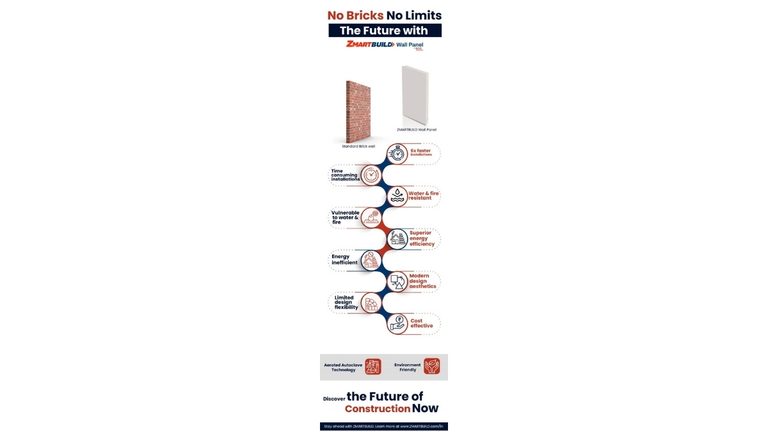
The Walling Opportunity Is Changing
India’s construction landscape is becoming increasingly driven by project timelines, scale and the need for consistent execution. Data centres, warehouses, industrial facilities, large residential developments and other large projects require construction methods that can deliver speed without compromising quality. At the same time, labour availability and the complexity of coordinating multiple activities on site are encouraging developers and contractors to look at ways of moving more work into controlled manufacturing environments.
This is where the evolution from conventional masonry and individual walling products towards lightweight, prefabricated walling systems becomes relevant. AAC wall panels can be manufactured in a controlled environment and brought to site for installation, helping shift a part of the wall-construction process away from the site itself.
From AAC Blocks to AAC Wall Panels
AAC blocks continue to be an important solution for lightweight wall construction. However, as projects become larger and construction schedules become tighter, the focus is increasingly moving from the material alone to the way the wall is delivered and installed. AAC wall panels address this requirement by combining lightweight construction with factory-enabled production and on-site installation.
For large projects, this can create a more streamlined sequence of work. Panels can be manufactured in advance, transported to the project and installed as part of a planned execution schedule. This can reduce the amount of walling activity that needs to be carried out manually at the site and can help improve predictability in project execution.
Customised Sizing: Designing the Wall Around the Project
One of the important advantages of AAC wall panels is the ability to consider project-specific dimensions rather than relying only on standard block sizes. Depending on project requirements and manufacturing capabilities, panels can be planned around the required wall dimensions, openings and installation conditions. This customised approach can help reduce unnecessary cutting and adjustments at site and can make the installation process more systematic.
For projects with repetitive layouts, large wall areas or specific dimensional requirements, the ability to plan panel sizes in advance can also support better material planning and coordination between manufacturing, logistics and installation. In this sense, customisation is not simply a product feature; it can become part of a more integrated construction workflow.
Where AAC Wall Panels Can Be Used
AAC wall panels can be particularly relevant in applications where speed, repeatability and lightweight construction are important. Potential use cases include internal and external non-load-bearing walls, partitions, large residential developments, commercial buildings, warehouses, industrial facilities and selected applications in data-centre construction, subject to project design, specifications and applicable standards.
Their relevance is especially visible in projects with large quantities of repetitive walling. In such environments, a factory-produced panel can help reduce the number of individual pieces that need to be handled and installed on site. The approach can also support better coordination when walling work has to progress alongside other construction activities.
Advantages Beyond Faster Installation
The potential advantage of AAC wall panels extends beyond installation speed. Factory-controlled production can help deliver greater consistency in dimensions and finish, while the lightweight nature of AAC can help reduce the dead load associated with wall construction. Prefabricated installation can also reduce site labour requirements and material handling, depending on the project methodology.
Industry experience indicates that wall panels can reduce walling-related construction time by around 30% to 50%, depending on the project, design, site conditions and execution methodology. The actual benefit will vary by application and should therefore be assessed against the overall project workflow rather than treated as a universal saving.
Another consideration is material efficiency. When panel dimensions are planned before production, the process can reduce the need for extensive cutting and modification at site. This can help minimise site waste and improve execution consistency, particularly in projects where wall dimensions are repeated across multiple floors or buildings.
Bigbloc’s Integrated Approach to Walling
Bigbloc Construction is building on its experience in AAC blocks while expanding towards a broader walling-solutions portfolio. Its offerings include NXTBLOC AAC blocks, ZMARTBUILD WALL AAC wall panels, NXTFIX jointing mortar and NXTPLAST ready mix plaster, covering key stages from wall construction to finishing.
The move towards wall panels is an extension of this approach. Rather than viewing walling as a single material decision, Bigbloc is focused on solutions that can work across manufacturing, installation and finishing. For developers and contractors, this creates an opportunity to look at walling as an integrated process, where product selection, dimensions, logistics and site execution are considered together.
Proven AAC Experience Across Large Developments
Bigbloc’s AAC blocks have been used across major developments including Lodha Group’s World One, L&T’s Crescent Bay and Palava Township. These applications demonstrate the relevance of lightweight AAC construction across high-rise and large integrated developments. The company’s experience in AAC provides a foundation as it expands its focus towards prefabricated walling solutions.
A More Resource-Efficient Approach to Construction
AAC is also relevant to the broader conversation around resource-efficient construction. Its lightweight characteristics can contribute to lower walling weight, while its thermal insulation properties can support energy-efficiency objectives. The use of fly ash in AAC production can also reduce dependence on conventional raw materials. Bigbloc has also registered an AAC block project under Verra’s Verified Carbon Standard.
As sustainability expectations become increasingly integrated into construction decisions, solutions that combine productivity with resource efficiency are gaining attention. For walling, this means evaluating not only the material itself but also how much labour, handling, waste and on-site activity are required to complete the wall.
Mohit Saboo, Director & CFO, Bigbloc Construction Limited, said:
“The next phase of walling is about more than replacing one material with another. It is about making the entire process more predictable—from how a wall is designed and manufactured to how it reaches the site and is installed. AAC wall panels give developers and contractors the ability to bring greater prefabrication, dimensional planning and execution efficiency into the walling process. At Bigbloc, our focus is on developing solutions that respond to these changing requirements while building on our experience in AAC construction.”
Looking Ahead
As India continues to build larger and more time-sensitive projects, the construction industry is likely to place greater emphasis on methods that combine speed, consistency and efficient site execution. AAC wall panels offer one route towards this evolution by moving a greater part of wall production into a controlled environment and bringing project-specific panels to site for installation.
For Bigbloc, the opportunity is to take its established AAC expertise into the next stage of walling—where customised sizing, prefabrication, integrated products and planned installation come together. The shift from blocks to panels is therefore not simply a change in format; it represents a broader move towards making wall construction faster, more systematic and better aligned with the needs of India’s large-scale construction projects.
(ADVERTORIAL DISCLAIMER: The above press release has been provided by PNN. ANI will not be responsible in any way for the content of the same.)